
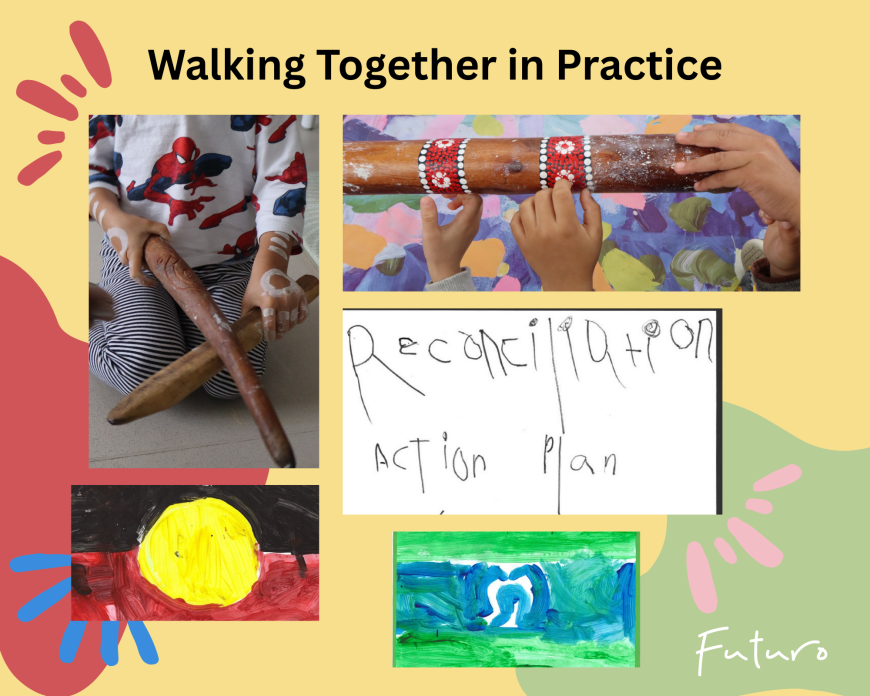
Our Gledswood Hills service has commenced work on a Reconciliation Action Plan, an important step in strengthening relationships between Aboriginal and Torres Strait Islander peoples and non-Indigenous peoples, for the benefit of all Australians.
This commitment does not come from obligation or compliance, nor simply from curriculum requirements within the Early Years Learning Framework. It comes from an understanding that the free, safe, and democratic society we live in today has been shaped by both the good and the painful aspects of our shared history.
As Aunty Munya Andrews reflects, it is possible to hold "both grief and pride at the same time... to honour survival without celebrating suffering, and to acknowledge the past without being trapped by it." (On Australia Day, we can acknowledge the past without being trapped by it, Sydney Morning Herald, 26 January 2026)
What Reconciliation means at Futuro
At Futuro, we honour the invitation of the Uluru Statement from the Heart to walk together by building respectful relationships with local communities, incorporating Indigenous perspectives into everyday practice, and supporting children to develop a strong sense of identity and belonging.
Reconciliation is not an event or a single policy. It is an ongoing commitment to relationship, respect and learning. By aligning our practices with the National Quality Framework's focus on equity, inclusion and valuing Aboriginal and Torres Strait Islander cultures, we aim to create culturally safe spaces and support children to grow into adults who understand and appreciate the richness of our shared history.
Shaping Learning with Care and Responsibility
This work is deeply connected to Futuro's purpose: to shape brighter futures by creating places of belonging, care and learning.
The word shape is intentional. We are not directive or prescriptive in our approach. Like a potter working with clay, we recognise the responsibility that comes with educating young minds. We listen carefully to children, their families and their social contexts, understanding that early experiences help shape how children see themselves, their community and their place in the world.
A Journey of Learning and Humility
Reconciliation means different things to different people. At Futuro, it means taking tangible steps to understand, recognise and embed Indigenous perspectives across all aspects of service life.
We acknowledge that reconciliation cannot be a box-ticking exercise. There will be moments of learning, reflection and, at times, missteps along the way. These moments should not discourage us, but instead remind us that meaningful change requires honesty, humility, and perseverance.
As Gledswood Hills Educational Leader Raiane Nicacio reflects, the journey of reconciliation reminds us that "we must un-learn as much as we learn." We embrace this mindset as an essential part of genuine education, approaching this work with openness, vulnerability and respect.
Walking Forward Together
Through this ongoing work, we aim to support children to understand and celebrate Indigenous perspectives within their local context, and to recognise how these perspectives shape their place in the wider world.
If you would like to learn more about our reconciliation initiatives, or share ideas and reflections, we welcome you to contact us at enquiries@futuro.nsw.edu.au.