
At Futuro Early Learning, we believe that every decision we make should place children's rights, safety, and well-being at the centre. As children grow up in an increasingly connected world, digital technology has become embedded in everyday life, including early childhood education.
Photography has long been used in early learning settings to document children's experiences and share moments of learning with families. However, growing awareness of children's digital footprints and online privacy has prompted us to reflect deeply on how images of children are shared.
Guided by the Early Years Learning Framework (EYLF v2.0) and our commitment to ethical practice, Futuro is strengthening our approach to photography by prioritising intentional, non-identifiable images.
This means continuing to make children's learning visible, while protecting their identity and rights in a digital world.
What We Mean by Non-Identifiable Images
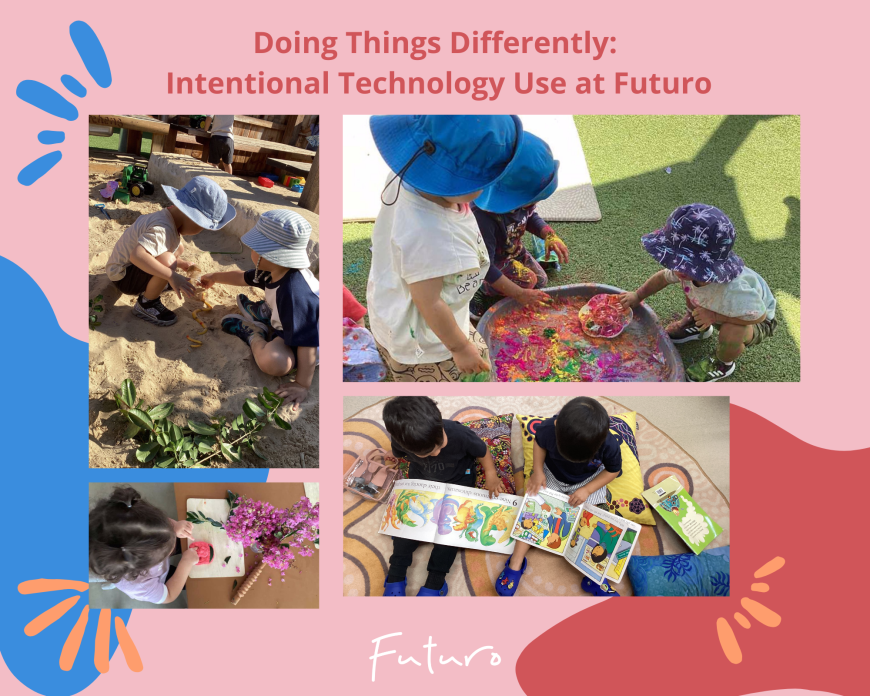
Non-identifiable images are photographs that do not show a child's face or any defining features that could reveal their identity. Instead, they focus on learning itself.
This might include:
- Children's hands engaged in play or investigation
- Creative work such as drawings, constructions, or artworks
- Materials and environments used during learning experiences
- Moments of collaboration or exploration captured from a respectful perspective
These images allow us to share the story of learning while protecting children's privacy. They also support Educators to remain present with children rather than constantly documenting posed photographs.
As researchers Semann and Slattery remind us:
"Children's safety and the risk of invisibility requires honest reflection."
This reflection is an important part of responsible and ethical early childhood practice.
Why This Matters
Every image shared online contributes to a child's digital footprint.
Once photographs are shared publicly, they can potentially be stored, reshared, altered, or accessed beyond our control. For young children who cannot yet provide informed consent about how their image is used, protecting their privacy becomes a shared responsibility between Educators, services, and families.
At Futuro, this reflection has led us to ask an important question:
How can we celebrate children's learning while safeguarding their identity?
Intentional non-identifiable images provide one way forward.
Listening to Children's Voices
Children themselves often have strong views about technology and photography.
In conversations across our services, children shared insights that helped guide our reflections:
"I really like not having the iPad." - L.A
"I don't like the iPads; I love to play" - W.E
These voices remind us that documentation should never interrupt meaningful play or relationships.
Our approach is also guided by Article 12 of the United Nations Convention on the Rights of the Child, which recognises that children have the right to express their views on matters affecting them. When we slow down and listen, children help shape practices that respect their agency and experiences.
Intentional Technology Use in Early Childhood
Digital technology can be a valuable tool when used thoughtfully and with purpose. The Early Years Learning Framework encourages Educators to use digital technologies intentionally to support learning, communication, and creativity.
At Futuro, intentional technology use means:
- Using digital tools thoughtfully rather than constantly
- Ensuring documentation supports reflection and learning
- Prioritising relationships and engagement over capturing images
- Considering children's rights, privacy, and safety in every decision
By adopting this approach, Educators are able to focus on being fully present with children while still sharing meaningful learnings with families.
Our Commitment Moving Forward
To strengthen children's privacy and rights, Futuro will be implementing a more intentional approach to image sharing across our services.
This includes:
- No longer sharing identifiable images of children's faces or defining features on social media platforms
- Focusing on purposeful photography that captures learning rather than constant capturing
- Prioritising non-identifiable images such as creative work, learning environments, and hands-on exploration
- Inviting children's participation wherever possible and supporting early conversations about consent and representatio
These practices allow us to continue celebrating learning while ensuring children's safety remains our priority.
Our Promise
At Futuro Early Learning, we are committed to protecting children's privacy while making learning visible in respectful ways.
Guided by our Paramountcy Principle, every decision we make prioritises children's rights, wellbeing, and dignity.
By thoughtfully reflecting on how we use technology and share images, we are supporting children not only as learners and communicators, but also as emerging digital citizens.